Now viewing
World runtime
Compiles evidence, agents, environments, interventions, and evaluation rules into reproducible simulation runs.
- Design intent
- Many worlds / one experiment
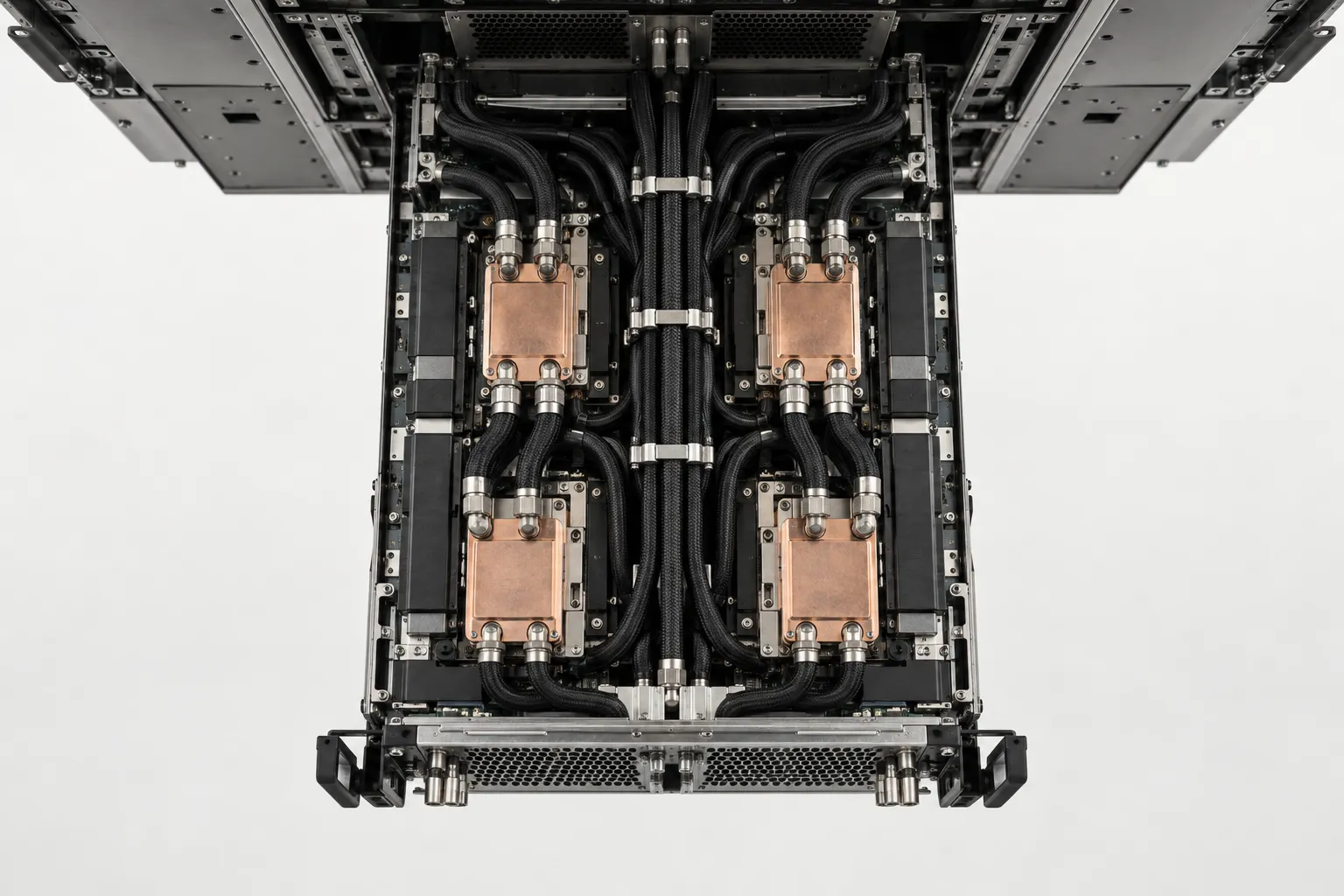
AI hardware for simulated time travel.
We co-design chips, racks, software, cooling, and manufacturing methods to compute multiple versions of our world with higher fidelity, measurable uncertainty, and reproducible results.
AI compute
World simulation is not one model running once. It is a coordinated system that can hold a world state, populate it with many interacting agents, fork alternatives, and preserve the evidence behind every result.
Our research asks what changes when that workload shapes the complete machine—from silicon and interconnects to software, cooling, and the way a cluster is manufactured.
From chip to cluster
The system grows without changing its purpose: keep more of a simulated world active, connected, and inspectable at once.

A purpose-shaped accelerator concept for agent inference, causal graphs, and long-horizon state transitions.
System architecture
A hybrid stack coordinates classical supercomputing today while keeping a clear research boundary around quantum methods.

Evidence, agents and alternative decisions
Power and liquid cooling support the compute racks. The quantum path is an exploratory interface for selected workloads.
Comparable futures, uncertainty and an auditable run record
Now viewing
Compiles evidence, agents, environments, interventions, and evaluation rules into reproducible simulation runs.
Research direction. Components, interfaces, and performance remain exploratory rather than released product specifications.
From transistor to timeline
Each layer is optimized around the same job: explore consequences while keeping the path from evidence to outcome visible.
Purpose-shaped compute for repeated inference, interaction graphs, sampling, and state transitions.
Memory, interconnect, liquid cooling, and power delivery designed for long-running worlds.
A runtime that compiles assumptions into branches and measures where their trajectories diverge.
Modular assemblies and serviceable cooling paths intended to scale without hiding system behavior.

World forks
A simulation cluster can hold a shared starting world, introduce one controlled difference, and evolve many futures in parallel. The value is not a single prophecy. It is seeing which outcomes remain stable and which assumptions change everything.
Quantum research layer
Quantum processors are not general replacements for supercomputers. Our long-horizon research asks whether carefully selected QPU workloads could assist sampling, optimization, or search inside a much larger classical simulation system.
Quantum information units whose useful behavior depends on carefully controlled superposition and entanglement.
The limited interval in which fragile quantum states remain usable before noise overwhelms them.
Methods that combine many physical qubits to protect a smaller number of logical qubits.
Research direction only. OpenX does not claim a deployed QPU, fault-tolerant quantum computer, or demonstrated quantum advantage.

Research targets
Simulation quality comes from validation, transparent uncertainty, and disciplined comparison with reality—not from claiming a perfect forecast.
Preserve the relationships that materially shape an outcome.
Expose confidence, assumptions, and plausible alternatives.
Replay a branch from the same evidence and configuration.
Continuously compare simulated behavior with observed reality.

Distributed AI compute
Explore dedicated GPU nodes hosted in homes, offices, shops, warehouses, enterprise sites and suitable public facilities, coordinated to run independent simulation branches.
Explore distributed computePartners in compute
We want to work with researchers, infrastructure teams, manufacturers, and technical partners who think world simulation deserves its own compute stack.
Build with us